
Leave your family a folder that tells them exactly what to do.
A will says who inherits. It doesn't tell your family who to call first, which account pays the mortgage, what the bank will ask for before it releases anything, or which deadlines start running in the very first weeks. Left Tidy does. It's the step-by-step plan for the first 30 days, 60 days and 6 months after a death in Canada, built on answers you write down once, so the people you love are never left guessing.

- Covers the three windows after a death in Canada: the first 30 days, 60 days and 6 months, each built around real Canadian deadlines.
- A step-by-step plan plus the records that feed it, in plain English, with no legal jargon.
- Twelve letters already written for the bank's estates department, Service Canada, the CRA, the pension plan, the insurers, and everyone else nobody tells automatically.
- CPP and registered plans, the way they actually work here: the CPP death benefit of $2,500 (up to $5,000 in some cases) that the executor should apply for within 60 days, the survivor's pension that pays back no more than 12 months, and the beneficiary on every RRSP, RRIF and TFSA that bypasses your will.
- About twenty minutes to start: the three sheets your family would need first.
Left Tidy · The Complete Folder · Canadian edition
- Delivered by email after purchase
- Fill in on screen or print at home
- 60-day money-back guarantee
- One payment, no subscription
For Canada outside Quebec. Quebec has its own civil-law system and is not covered by this edition.
When you're gone, the paperwork doesn't stop. It lands on the people you love.
Between the day someone dies and the day the estate is settled, there's a run of deadlines, phone calls and forms that nobody prepares for. In Canada nobody takes it off the family's hands: not the government, not the bank, not the pension plan. It falls to the family, usually a spouse, a daughter or a son doing it for the first time. This is what it looks like from the kitchen table.
The search through the drawers
Your children go through old statements, a filing cabinet full of paper and a phone they can't unlock, trying to work out which banks, pension plans and policies even exist. The deed to the house. The pension from a job in 1998. The policy in a shopping bag in the garage.
With the folder: every account is already listed, with what to do about it.
Your RRSP doesn't follow your will
It follows the beneficiary named on the plan, often years ago. RRSPs, RRIFs, TFSAs, workplace pensions and life insurance with a named beneficiary are paid straight to that person, outside your will. Nobody writes to tell your family which plans exist.
With the folder: every plan, every beneficiary or successor holder, and the date you last checked it.
Money tied up, bills still coming
An account in your name alone becomes part of your estate, and banks often want probate before they release it, each with its own threshold. Your power of attorney ends the moment you die, so nobody can simply step in with it. Meanwhile the mortgage, the utilities and the condo fees keep coming.
With the folder: your family knows what exists, who the executor is, and which account keeps the household running.
is the most the CPP survivor's pension will pay back (Service Canada, 2026). Payments start at the earliest the month after the death, and back pay covers 11 months plus the month you apply. A surviving spouse who applies two years late simply never sees the rest, and in 2026 the pension is worth up to $904.59 a month at 65 or older.
None of that is a legal problem. It happens because nobody left a plan to follow.
"They'll figure it out, won't they?"
They would, in the end: after months of phone calls, an account nobody can touch, CPP payments to send back and a pension plan that went quiet. What spares them those months is a plan they can follow, what to do first, who to contact next, and where everything is kept.
One simple plan, in three stages: the 30-60-6 plan.
It follows real Canadian dates: a first month to secure the home and stop the payments (many home insurers treat a house as vacant after 30 days, and CPP or OAS paid after the month of death has to go back), 60 days for the executor to apply for the CPP death benefit, and 6 months in which several key deadlines fall, from the final tax return for a death in November or December to Ontario's six-month spousal election. At every stage the folder tells your family exactly what to do next, so nobody has to improvise.
Secure the urgent things
The first actions, in order: 911 if the death was unexpected, the doctor if it was expected; the funeral director, who usually handles the registration before the burial permit; several death certificates from your province; the original will; the executor told; Service Canada and the CRA called; the home insurer told before the house sits empty for 30 days; and for a renter in Ontario, the landlord, since a sole tenant's lease ends 30 days after the death.
Without a planThe funeral paid from someone's own pocket, CPP payments to send back, an empty house the insurer was never told about.
Tell the right people, in order
The CPP death benefit, $2,500 and up to $5,000 in some cases, which the executor should apply for within 60 days, with the survivor's pension applied for at the same time. Then the bank's estates department, the pension plan, the RRSP and TFSA institutions, the insurers, the employer, the utilities, one by one, with the letters ready to send.
Without a planThe death explained again on every call, a death benefit nobody claimed, a survivor's pension applied for too late.
Settle it properly
Probate through your province's court where it's needed (in Ontario, the Certificate of Appointment of Estate Trustee). The final tax return: due 6 months after the death if it happened in November or December, otherwise by April 30 of the following year. The land registry, the registered plans, the family claim windows. Then the debts, the CRA clearance certificate before anything is handed out, and who gets what, with the documents a lawyer or accountant will ask for, in order.
Without a planThe home that can't be sold, a tax bill that lands on the executor personally, arguments in the family.
Two things in one folder: the plan, and the records that feed it.
The plan tells your family what to do. The records you fill in tell them where everything is. Every part is written for Canada outside Quebec, and where your province or territory does something differently, the page says so:
- The step-by-step plan: the Start Here page with the first five things to do, the 30-60-6 plan, the two federal calls to Service Canada and the CRA, what happens automatically and what doesn't, and who to tell, in order.
- The Family Folder: fourteen guided sheets for every account, pension, registered plan, policy and bill, the home, the phone, your power of attorney and health care directive under your province's own names, and where the will is kept.
- Twelve letters, already written: the bank, the mortgage lender, the pension plan or RRSP institution, Service Canada, the life insurer, the CRA, the investment platform, the municipality and more. Add the name, sign and send.
- The Executor's Brief, for executors, estate trustees and administrators: probate and its fees province by province, the 6-month calendar that follows the 30-60-6 plan, the final tax return, the clearance certificate that protects the executor personally, and a sheet that hands everything to a lawyer or accountant.
- The Home Pack & Will Safeguard, for owners and renters: joint tenancy or tenants in common, the provincial land registry, the lease after a death, where the will is kept, plus an empty-home checklist for the keys, the heat, the pipes, the snow, the mail and the insurer.
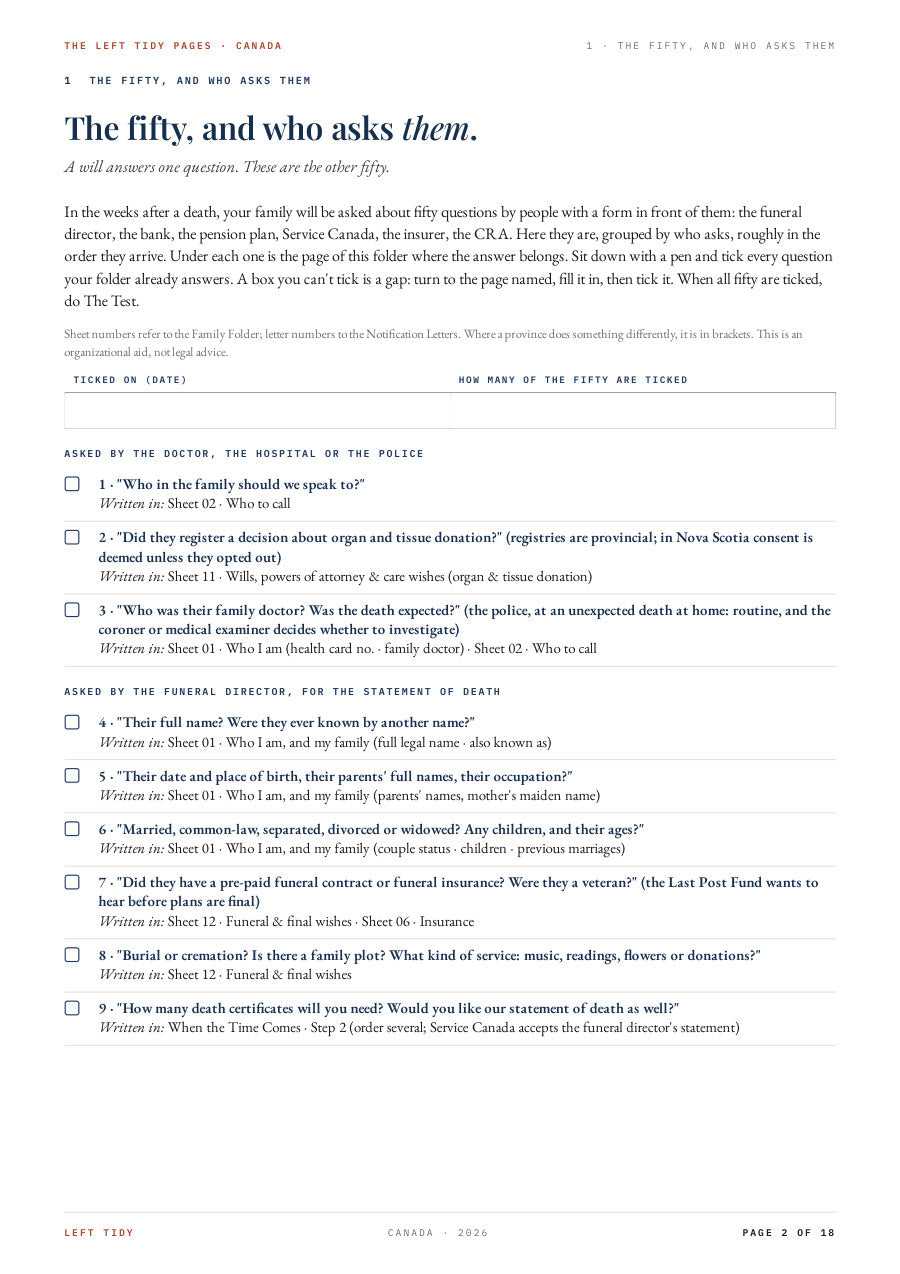
- The Fifty, The Test, the Digital Doors and the Empty House: the fifty questions your family will be asked in the first months, each pointing to its answer, a twenty-minute test that proves the folder works, the way into the phone and the online accounts, and the house looked after when nobody lives in it.
- The Guide: 24 pages in plain English, every figure with its source.
Delivered by email after purchase · fill it in on screen or print it at home · keep it all together in one folder.


See the real pages before you buy.
Swipe through twelve pages from the Canadian edition, and tap any page to read it full size.



You do it once, calmly, over an afternoon.
Every sheet asks plain questions and tells you exactly what goes where, so there's no blank page, no jargon and no legal training needed. You go at your own pace, and you can stop whenever you like.

1Start with three sheets tonight
Who you are, where everything is kept, and your bank accounts. Those three answer most of what your family will be asked in the first month, and they take about twenty minutes, on screen or on paper.
2Test it on a Sunday
Hand the closed folder to the person who'd use it and start a timer. If they can find your will, the account the mortgage comes out of and the person to call about your pension in twenty minutes, it works. Write the date on the cover.
3Leave it where they'll look
Keep it with your important papers and tell one person where it is. On the day it's needed, the first page tells them what to do, and ten minutes once a year keeps everything up to date, including the beneficiary on every plan after a marriage, a separation or a new grandchild.
When that day comes, there are two versions of it.
Both families love the person they've lost. The difference is whether that person left them a plan.
Without a plan
- Drawers turned out, looking for accounts nobody knew existed
- The same death explained on call after call, in no order
- An RRSP from an old job, with a beneficiary nobody has checked in years
- Money tied up while the mortgage and the bills keep coming
- A phone nobody can unlock, and the photos inside it
- An empty house, and an insurer who wasn't told
- One child carrying it all, the others second-guessing
- Grief, with the paperwork piled on top
With the folder
- Every account, pension and policy already listed
- A clear order of who to contact, with the letters written
- Every beneficiary checked, nothing quietly lost
- The right steps, taken in the right order, in your province
- The way into the phone, kept where one person can find it
- The house looked after from the first week
- Everyone working from the same pages
- Room to actually grieve
One folder, with everything in it, at one price.
There are no levels to choose between and nothing to upgrade to later. Everything your family will need is in the one folder, for every province and territory outside Quebec.
Left Tidy · The Complete Folder · Canadian edition
For anyone who wants to leave their family a plan, with or without a will.
One payment. No subscription.
- The step-by-step plan: Start Here, the 30-60-6 plan and who to tell
- The Family Folder: fourteen guided sheets
- Twelve notification letters, ready to send
- The Executor's Brief: probate, the final tax return and the clearance certificate
- The Home Pack & Will Safeguard, for owners and renters
- The Fifty, The Test, the Digital Doors and the Empty House pages
- The Guide, 24 pages in plain English
- Every province and territory outside Quebec, the differences flagged
- For couples: one folder covers both of you
- Delivered by email after purchase, plus Word versions
- 60-day money-back guarantee
Probate alone can cost thousands: Ontario's own example is $2,850 in Estate Administration Tax on an estate worth $240,000 (2026), and every province sets its own fees. The folder doesn't replace a lawyer or an accountant. It gives your family, or whoever helps them, everything they'll be asked for on the first day.
A simple 60-day money-back guarantee
Open the folder, read the Guide, fill in the first sheets and run The Test with your family. If you don't feel it helps them know what to do, let us know within 60 days and we'll refund you in full. No forms and no questions.
Everything you might be wondering
Is it just a place to write things down?
No, and that's the important part. It's a step-by-step plan: what to do, who to contact and in what order, across the first 30 days, 60 days and 6 months. The sheets you fill in feed that plan, so your family can simply follow it.
We've already made a will. Do we still need this?
A will says who inherits. It doesn't tell your family where everything is, which pension plan to call, what to cancel or who to contact first. And when a beneficiary is named on an RRSP, RRIF, TFSA, pension or life insurance policy, that money goes straight to that person, outside the will. That practical plan is what the folder gives them, and the two work together, so write down in the folder where your will is kept.
Every province is different. How can one folder cover Canada?
Because the path is much the same across the common-law provinces: the death is registered before the burial permit, Service Canada and the CRA are told, a court confirms the executor where probate is needed, and registered plans pass to the beneficiary named on them. CPP, OAS and income tax are federal and work the same everywhere. Where your province or territory differs, the folder says so on the page: the name of your power of attorney (in Ontario, the Continuing Power of Attorney for Property), probate fees that run from nothing in Manitoba to $15 for every $1,000 above $50,000 in Ontario, a coroner or a medical examiner, and whether a handwritten will counts. There's a line on the first sheet for the province you live in. Quebec has its own civil-law system and is not covered by this edition.
How do I get the folder?
By email. After you buy, you'll get an email with the link to download your folder. Fill it in on screen and save it on your computer, or print it at home and keep it in a binder you already own.
Do I need a printer?
No. Every sheet can be filled in on screen and saved, and Word versions are included. If you'd like your family to have something on paper, print the eight "When the Time Comes" pages they'll open first, starting with Start Here and the calendar. Any home printer with Letter-size paper will do, or Staples, a library or a print shop.
Is my information safe?
Nothing you type is sent to us: the file stays on your own computer, with no account, app or cloud. A bank PIN, a full card number or the passwords to your CRA My Account and My Service Canada Account never go in the folder: an executor never needs them, and gets access to the tax file through the CRA's Represent a Client service instead. Passwords go on one sheet only, written in full or as where each one is kept. A password list is not a power of attorney, and the folder belongs somewhere safe, like a locked drawer.
Doesn't the government tell everyone?
No. When a death is registered in a province, the province tells the federal SIN Program, and the CRA gets the information too. But Service Canada still asks the family to report the death so CPP and OAS are cancelled, and only the payment for the month of death belongs to the estate: anything after that goes back. In the territories, the family tells the SIN Program itself. Banks, insurers, pension plans, the landlord, the utilities and everyone else hear nothing until someone tells them, because Canada has no single service that notifies everyone at once. The twelve letters cover them, in order.
Who writes this, and is it really Canadian?
Left Tidy is a family folder first written for the UK and rebuilt page by page for Australia and then for Canada, by the same people. The rules, fees and deadlines in the Canadian edition were checked in November 2026, wherever possible against the official source: Service Canada, the CRA, provincial governments and their statutes, and the provincial probate fee schedules. The sources are printed in the Guide so you can check them yourself. Nothing is imported from an American planner: no Social Security, no 401(k), no living trust.
Isn't it a bit morbid?
It's the opposite. It's organizing, the same as keeping your insurance papers in order, and it's far kinder to do it now, calmly, than to leave it to someone in shock.
Can I buy it for Mom or Dad?
Yes. Buy it, share the file and fill in the first sheet together. "I'm doing mine, will you do yours with me?" is the easiest way to bring it up.
What if I buy it and never fill it in?
Start with the three sheets that matter most: they take about twenty minutes. Then run The Test on a Sunday. And if it isn't right for you, the 60-day guarantee means you get your money back.
Is it legal advice?
No. It isn't a will, and it isn't legal, tax or financial advice. It's the practical plan for everything a will doesn't cover, and it tells your family when a lawyer, the probate court registry, Service Canada, the CRA or an accountant is worth calling; your provincial law society's referral service can point you to a lawyer. It's also why the folder deliberately has no fill-in will template: a will is made with a lawyer or under your province's own rules.
One last thing for the people you love
You've looked after them all your life. Make the last thing you leave them easy to follow.
One afternoon now spares them months of searching later. Start with three sheets tonight, test it on a Sunday, and leave it where they'll look.
59% OFF Regular price €108,95 Sale price €43,95, once · 60-day money-back guarantee · every province and territory outside Quebec
Left Tidy is not a will, and it is not legal, tax or financial advice. It is a practical plan and organizer that helps your family find what they need and know where to start. For Canada outside Quebec. Quebec has its own civil-law system and is not covered by this edition. Rules, fees and deadlines differ between provinces and territories and change over time, so check the current position with the body named on each page, or with a lawyer or accountant. General information, not legal or tax advice.