
Leave your family a folder that tells them exactly what to do.
A will says who inherits. It doesn't tell your family who to ring first, which account the mortgage comes out of, what Revenue needs before anyone can apply for probate, or which payment from the Department of Social Protection carries on for six weeks. Left Tidy does. It's the step-by-step plan for the first 6 weeks, 3 months and 12 months after a death in Ireland, built on answers you write down once, so the people you love are never left guessing.

- Covers the three windows after a death in Ireland: the first 6 weeks, 3 months and 12 months, each built on a real Irish deadline.
- A step-by-step plan plus the records that feed it, in plain English, with no legal jargon.
- Twelve letters already written for the bank, the credit union, the pension scheme, the Department of Social Protection, Revenue, the insurers and everyone else who has to be told one by one.
- Pensions and payments, the way they actually work here: the six weeks a surviving partner keeps receiving many payments, the Bereaved Partner's Pension from week 7, and the pensions, life policies and credit union nominations that bypass the will.
- About twenty minutes to start: the three sheets your family would need first.
Left Tidy · The Complete Folder · Irish edition
- By email after purchase
- Fill in on screen or print at home
- 60-day money-back guarantee
- One payment, no subscription
When you're gone, the admin doesn't stop. It lands on the people you love.
Between the day someone dies and the day the estate is settled, there's a run of deadlines, phone calls and forms that nobody prepares for. In Ireland nobody takes it off the family's hands: not the registrar, not the bank, not the Department. The family even registers the death itself. It usually falls to a spouse, a daughter or a son doing it for the first time. This is what it looks like from the kitchen table.
The search through the drawers
Your children go through old statements, a filing cabinet full of paper and a phone they can't unlock, trying to work out which banks, pension schemes and policies even exist. The deeds to the house. The pension from a job in 1998. The policy in a shopping bag in the garage.
With the folder: every account is already listed, with what to do about it.
Your pension and life cover don't follow your will
A death benefit paid to someone named under a pension scheme or a life policy passes outside the will. So does up to €27,000 in a credit union account with a nomination, and a home owned as joint tenants. Your will can say one thing and the paperwork another, and nobody hands your family a list of which schemes exist.
With the folder: every scheme, every policy, who is named, and the date you last checked.
Money held, bills still coming
An account in one name usually can't be touched until the grant of probate comes through, though some banks release a balance under €20,000 on their own terms. A joint account with anyone but a spouse or civil partner can need Revenue clearance first, above €50,000. Meanwhile the loan repayments, the electricity and the insurance keep coming.
With the folder: your family knows what exists, and which account keeps the household running.
is how long a family applying for probate itself can wait just for the appointment: dates are usually issued 10 to 12 weeks after the papers are lodged, and the grant is posted about 3 weeks after that (Courts Service, November 2026). The papers can't go in until Revenue's Form SA.2 is filed, with every asset and debt valued at the date of death. Until the grant, money in the person's sole name usually stays where it is, and the Dublin Probate Office won't speed up an application to help a house sale.
None of that is a legal problem. It happens because nobody left a plan to follow.
"Surely they'll work it out?"
They would, in the end: after months of phone calls, an account nobody can touch, a pension payment to pay back and a deadline nobody knew about. What spares them those months is a plan they can follow, what to do first, who to contact next, and where everything is kept.
One simple plan, in three stages: the 6-3-12 plan.
It follows the real Irish clocks, all counted from the date of death: the 6 weeks in which many social welfare payments carry on to the surviving partner, the 3 months to register the death and claim the Bereaved Partner's Pension, and the executor's year, the 12 months the law gives the executor before anyone can press for the estate to be shared out. At every stage the folder tells your family exactly what to do next, so nobody has to improvise.
Secure the urgent things
The first actions, in order: the doctor's Death Notification Form, or 112 or 999 and the Gardaí if the death was sudden; the funeral director, with an itemised price and any pre-paid plan; the section of the Department of Social Protection that paid the person, told in the first few days; the original will, usually with the solicitor; sole and joint accounts noted before any bank is called; Revenue told.
Without a planThe funeral paid from someone's own pocket, a pension payment collected that has to go back, the will found too late.
Register, claim, and tell, in order
The death registered by the family at any civil registration office, free, with several certificates at €20 each. The Bereaved Partner's Pension claimed, paid from week 7. Then the banks, the credit union, every pension scheme, the insurers and the employer, one by one, with the letters ready to send. Revenue's Form SA.2 filed online and the probate application lodged.
Without a planThe death explained again on every call, a pension claimed late and backdated six months at most, a policy nobody knew about.
Settle it properly
The probate appointment and the grant. The spouse or civil partner told in writing of the legal right share and the right to the home, the creditors' notices, the Department asked about any overpayment, tax settled to the date of death. Then the 6-month windows from the grant for a child's or a cohabitant's claim, and only then who gets what, with the documents a solicitor will ask for, in order.
Without a planAn estate shared out too early and an executor personally liable, a claim nobody saw coming, arguments in the family.
Two things in one folder: the plan, and the records that feed it.
The plan tells your family what to do. The records you fill in tell them where everything is. Every part is written for Ireland, where one law covers every county, and where something is local, like the burial ground rules or which probate registry serves your county, the page says so:
- The step-by-step plan: the Start Here page with the first five things to do, the 6-3-12 plan, the six weeks with the Department of Social Protection, who is told automatically and who isn't, and everyone else to tell, in order.
- The Family Folder: fourteen guided sheets for every account, pension, policy and bill, the home, the phone, the enduring power of attorney, the advance healthcare directive, and which solicitor holds the will.
- Twelve letters, already written: the bank or credit union, the mortgage lender, the pension scheme, the Department of Social Protection, the life insurer, Revenue, the employer, the energy supplier and more. Add the name, sign and send.
- The Executor's Brief, for the executor, or the administrator where there is no will: Revenue's Form SA.2, applying for the grant yourself or through a solicitor, the Probate Office fees, the legal right share, the 6-month windows, the executor's year, and a sheet that hands everything to a solicitor.
- The Home Pack, for owners and renters: joint tenants or tenants in common, the Land Registry at Tailte Éireann, mortgage protection, deferring the Local Property Tax, a tenancy after a death, plus an empty-house checklist for the insurer, the heating, the keys and the post.
- The Fifty, The Test, Digital Doors and The Empty House: the fifty questions your family will be asked in the first months, each pointing to its answer, a twenty-minute test that proves the folder works, the way into the phone and the online accounts, and the house looked after when nobody lives in it.
- The Guide: 22 pages in plain English, every figure with its source.
By email after purchase · fill it in on screen or print it at home · keep it all together in one folder.


See the real pages before you buy.
Swipe through twelve pages from the Irish edition, and tap any page to read it full size.




You do it once, calmly, over an afternoon.
Every sheet asks plain questions and tells you exactly what goes where, so there's no blank page, no jargon and no legal training needed. You go at your own pace, and you can stop whenever you like.

1Start with three sheets tonight
Who you are, where everything is kept, and your bank accounts. Those three answer most of what your family will be asked in the first month, and they take about twenty minutes, on screen or on paper.
2Test it on a Sunday
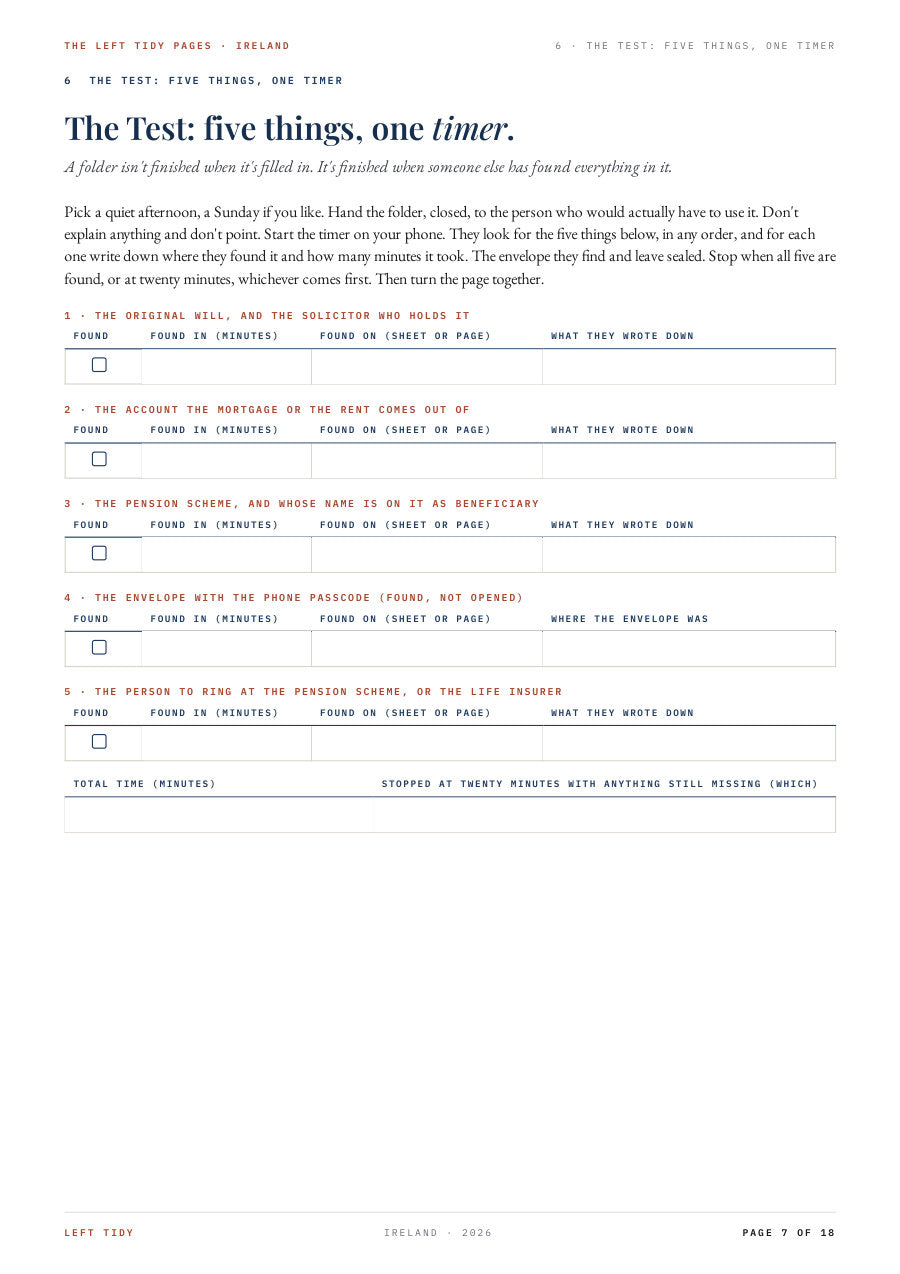
Hand the closed folder to the person who'd use it and start a timer. If they can find your will, the account the mortgage comes out of and the person to ring about your pension in twenty minutes, it works. Write the date on The Test page.
3Leave it where they'll look
Keep it with your important papers and tell one person where it is. On the day it's needed, the first page tells them what to do, and ten minutes once a year keeps everything up to date, including who is named on your pensions, life policies and credit union nomination.
When that day comes, there are two versions of it.
Both families love the person they've lost. The difference is whether that person left them a plan.
Without a plan
- Drawers turned out, looking for accounts nobody knew existed
- The same death explained on call after call, in no order
- A pension from an old job, and a named beneficiary nobody has checked in years
- An account nobody can touch while the repayments and the bills keep coming
- A phone nobody can unlock, and the photos inside it
- An empty house, and an insurer who wasn't told
- One child carrying it all, the others second-guessing
- Grief, with the admin piled on top
With the folder
- Every account, pension and policy already listed
- A clear order of who to contact, with the letters written
- Every named beneficiary checked, nothing quietly lost
- The right steps, taken in the right order, with every deadline in view
- The way into the phone, kept where one person can find it
- The house looked after from the first week
- Everyone working from the same pages
- Room to actually grieve
One folder, with everything in it, at one price.
There are no levels to choose between and nothing to upgrade to later. Everything your family will need is in the one folder, written for Ireland.
Left Tidy · The Complete Folder · Irish edition
For anyone who wants to leave their family a plan, with or without a will.
One payment. No subscription.
- The step-by-step plan: Start Here, the 6-3-12 plan and who to tell
- The Family Folder: fourteen guided sheets
- Twelve notification letters, ready to send
- The Executor's Brief, the 12-month calendar and the grant, step by step
- The Home Pack, for owners and renters
- The Fifty, The Test, the Digital Doors and the Empty House pages
- The Guide, 22 pages in plain English
- Irish law, Irish forms: Revenue, the Probate Office, the Department of Social Protection
- For couples: one folder covers both of you
- By email after purchase, plus Word versions
- 60-day money-back guarantee
Applying for probate yourself costs €200 in Probate Office fees on a net estate up to €100,000, €400 up to €250,000 and €700 up to €500,000. Through a solicitor the office fee is about half, and the solicitor's own charges come on top (Courts Service, 2026). The folder doesn't replace a solicitor. It gives your family, or whoever helps them, everything they'll be asked for on the first day.
A simple 60-day money-back guarantee
Open the folder, read the Guide, fill in the first sheets and run The Test with your family. If you don't feel it helps them know what to do, let us know within 60 days and we'll refund you in full. No forms and no questions.
Everything you might be wondering
Is it just a place to write things down?
No, and that's the important part. It's a step-by-step plan: what to do, who to contact and in what order, across the first 6 weeks, 3 months and 12 months. The sheets you fill in feed that plan, so your family can simply follow it.
We've already made a will. Do we still need this?
A will says who inherits. It doesn't tell your family where everything is, which pension scheme to ring, what to cancel or who to contact first. And some of the biggest amounts never go through the will at all: a pension or life policy with a named beneficiary, a credit union nomination, a home owned as joint tenants. That practical plan is what the folder gives them, and the two work together. Ireland has no national register of wills, so the folder also records exactly which solicitor holds the original.
Does it matter which county I live in?
No. One law covers the whole country: wills, probate, Capital Acquisitions Tax, social welfare and powers of attorney work the same way in every county. Only two things are local, and the folder says so on the page: burial ground rules, set by the local authority or the parish, and where the probate papers go. Dublin, Kildare, Meath and Wicklow apply to the Probate Office in Dublin; anywhere else can use Dublin or the District Probate Registry for the county where the person lived. The folder is written for the Republic of Ireland; Northern Ireland is a different jurisdiction and isn't covered.
How do I get the folder?
By email. After your purchase you get an email with the link to download your folder. Fill it in on screen and save it on your computer, or print it at home and keep it in a folder you already have.
Do I need a printer?
No. Every sheet can be filled in on screen and saved, and Word versions are included. If you'd like your family to have something on paper, print the eight "When the Time Comes" pages they'll open first, starting with Start Here and the 6-3-12 plan. Any home printer will do, or a library or any print shop.
Is my information safe?
Nothing you type is sent to us: the file stays on your own computer, with no account, app or cloud. A bank PIN or a full card number never goes in the folder, because an executor never needs them. Passwords go on one sheet only, written in full or as where each one is kept, and the folder belongs somewhere safe, like a locked drawer, a home safe or with your solicitor.
Doesn't registering the death tell everyone?
No. Once the death is registered, the Department of Social Protection can see it, but the section that paid the person should still be told directly. After the grant, the Probate Office sends the papers to Revenue, but Revenue still expects the executor to tell it about the death as soon as possible. The register of electors needs a separate request to the local authority. We know of no Irish service that tells the banks, credit unions, pension schemes, insurers and utilities all at once, so each one hears it from the family. The twelve letters cover those, in order.
Who writes this, and is it really Irish?
Left Tidy is a family folder first written for the UK and rebuilt page by page for Australia and then for Ireland, by the same people. The rules, fees and deadlines in the Irish edition were checked in November 2026, wherever possible against the official source: the statutes, Citizens Information, Revenue, the Courts Service and the Probate Office, the Department of Social Protection, the Decision Support Service and Tailte Éireann. The sources are printed in the Guide so you can check them yourself. Nothing is carried over from another country's edition: the Irish forms, bodies and deadlines are the ones in the folder.
Isn't it a bit morbid?
It's the opposite. It's organising, the same as keeping your insurance papers in order, and it's far kinder to do it now, calmly, than to leave it to someone in shock.
Can I buy it for my mam or dad?
Yes. Buy it, share the file and fill in the first sheet together. "I'm doing mine, will you do yours with me?" is the easiest way to bring it up.
What if I buy it and never fill it in?
Start with the three sheets that matter most: they take about twenty minutes. Then run The Test on a Sunday. And if it isn't right for you, the 60-day guarantee means you get your money back.
Is it legal advice?
No. It isn't a will, and it isn't legal, tax or financial advice. It's the practical plan for everything a will doesn't cover, and it tells your family when a solicitor, the Probate Office, Revenue, the Department of Social Protection, the Decision Support Service or Citizens Information (0818 07 4000) is worth calling. It's also why the folder has no fill-in will: in Ireland a will must be signed in front of two witnesses present at the same time, and a witness loses any gift left to them in it, so a will is a job for a solicitor.
One last thing for the people you love
You've looked after them all your life. Make the last thing you leave them easy to follow.
One afternoon now spares them months of searching later. Start with three sheets tonight, test it on a Sunday, and leave it where they'll look.
59% OFF Regular price €108,95 Sale price €43,95, once · 60-day money-back guarantee · written for Ireland
Left Tidy is not a will, and it is not legal, tax or financial advice. It is a practical plan and organiser that helps your family find what they need and know where to start. It is written for the Republic of Ireland. Rules, fees and deadlines change, so check the current position with the official body named on each page, with a solicitor, or with Citizens Information (0818 07 4000). General information, not legal or tax advice.